Episode 6A - Chapter 3: Money, or Commodity Circulation [p. 69-117]
Show Notes
Yet to be released!
Real Contradictions
Right at the beginning of Chapter 3.2 The Means of Circulation, Marx says something rather interesting.
“We saw earlier that the exchange process of commodities implies contradictory and mutually exclusive conditions. As commodities develop, these contradictions don’t disappear, but a form arises in which they can move. Real contradictions are generally resolved in this way. We express a contradiction, for example, when we say that one body is constantly both falling toward another body and falling away from it. The ellipse is one of the forms of motion through which this contradiction is just as much realized as resolved.” (p. 78) DEMEW 23:119 Man sah, daß der Austauschprozeß der Waren widersprechende und einander ausschließende Beziehungen einschließt. Die Entwicklung der Ware hebt diese Widersprüche nicht auf, schafft aber die Form, worin sie sich bewegen können. Dies ist überhaupt die Methode, wodurch sich wirkliche Widersprüche lösen. Es ist z.B. ein Widerspruch, daß ein Körper beständig in einen andren fällt und ebenso beständig von ihm wegflieht. Die Ellipse ist eine der Bewegungsformen, worin dieser Widerspruch sich ebensosehr verwirklicht als löst.
Now, I’ve been saying throughout the show that something like dimensionality has been useful to me in thinking about the theory that Marx develops. My go to geometric not-from-Marx example is that a circle is a form of appearance of a cylinder/can (the one that you get when you look at it from the top). That’s a two-dimensional “appearance” of a three-dimensional object - and appearances like that are something like partial truths (but which one must not mistake for the whole truth). Etc. Marx himself gives plenty of examples like that, both geometric and non-geometric. In chapter 1.4 (p. 49), for example, he discusses the “mystery of the commodity-form” - it “reflects back at people the producers’ relation to the totality of labor as a social relation among objects that exists apart from and outside the producers themselves”. And as an illustration he chooses vision: he says that vision is about (at the very least, I might carefully add) a relation between the eye and some external object that we’re seeing, but we experience it merely as the form of the thing perceived. There’s two sides to vision - we might say vision is a relation between an eye and a thing, which is in turn mediated by light. But our experience of seeing is simply about the form of the thing. We can call this, too, a dimensionality reduction: a relation (vision), something that pertains to two things, appears as a property (shape), something that pertains to just one thing. Or - a two-dimensional thing appears as merely one of its dimensions, and hence a one-dimensional thing.
So what’s going on with the ellipse, another geometric example? Let me walk you through the geometry and contradiction of it, as I understand it. What we have here is, I believe, an increase in dimensionality! Marx calls it a contradiction “that one body is constantly both falling toward another body and falling away from it”. Sounds true enough! So, what the hell is he talking about with that ellipse? Well, we could treat distance as simply a number, a one-dimensional thing (something simply measured in, say, meters) – and then distance can indeed not increase and decrease at the same time. The same number can’t go up and down at the same time.
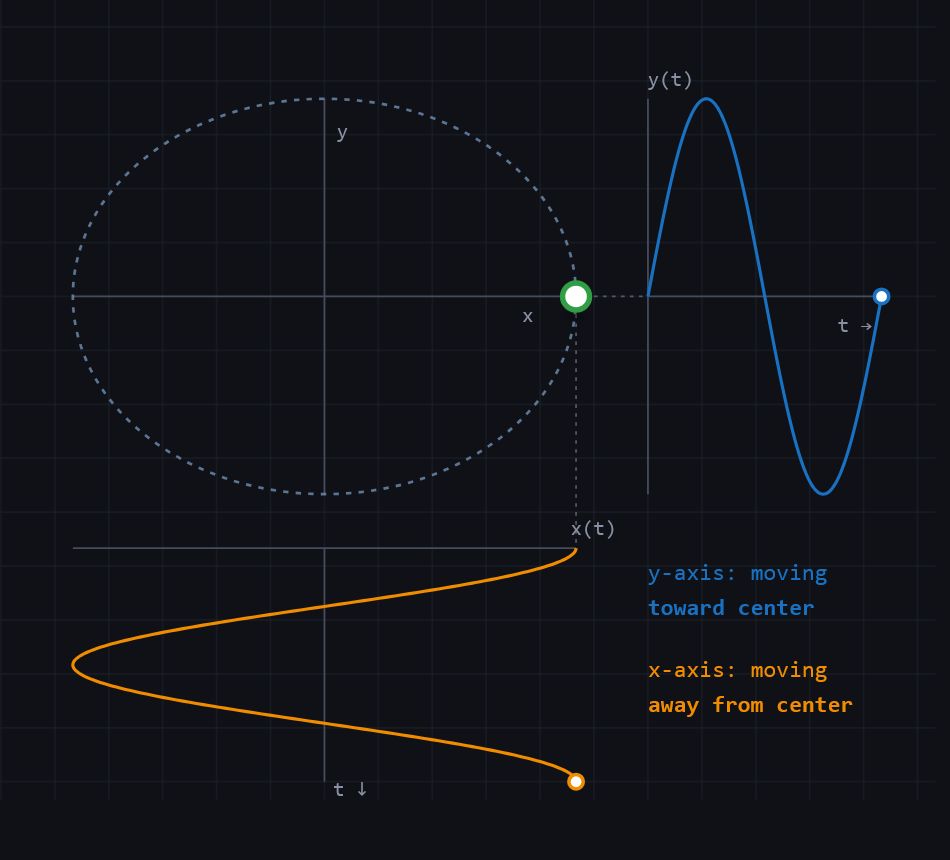
But we could also treat distance as a thing with two components, in a two-dimensional system - x/y coordinates. Perhaps the two components get a certain amount of “relative independence”. One may increase, while the other one decreases. Let’s take a look: Our green dot moves along an elliptical path (with t indicating time passing). When we break down distance into the two components of the x-axis and the y-axis, they look like this. Play around with it:
Tracing an ellipse
If you look carefully (or read the text in the bottom right), an elliptical path is actually a form in which, whenever x increases, y decreases - and vice versa. That is to say, whenever our green dot is, in one dimension, “falling toward another body”, it is “falling away from it” in the other one. This is not an accidental property of an ellipse - it’s a necessary, definitional, characteristic property of ellipses. You can’t have an ellipse without this property. And hence, the particular kind of “unity” of X and Y that we call an ellipse is among the “forms of motion through which this contradiction is just as much realized as resolved.”
And what are we talking about in this particular chapter? Well, since the very beginning of the book, we have been talking about the fact that commodities have an internal contradiction – that between Use Value and Value (a contradiction between two different ways of relating to an object). And now we are talking about the fact that these two things start to have their own, interrelated but distinct forms of movement. Money, the form of value, continually circulates, while use values continually enter the sphere of circulation, and continually leave it. Use value and value form “inner unity [that] moves via external oppositions”.
Towards the end of the section (p. 87), Marx says this:
“No one can sell unless someone else buys. But no one needs to buy immediately just because he’s sold something else. Circulation explodes the temporal, spatial, and individual limits that go with the direct exchange of products, and it does so by breaking up the immediate identity involved in direct exchange—disposing of one’s own labor product and acquiring someone else’s. What was once that immediate identity now becomes the opposition between selling and buying. These processes take place as mutually independent opposites but form an inner unity, which means that this inner unity moves via external oppositions. If things that complete each other internally, and thus aren’t independent, become externally independent past a certain point, then their unity will make itself felt with great force, by way of … a crisis. The commodity contains an inherent opposition: use-value versus value”
Exchange value becomes ever more independent (the opposition becomes external, in the form of money), but this independence exists properly only within the very form of motion. Within circulation, we see that “the contradiction is just as much realized as resolved” - money is only money because commodities are continually being made commensurable with one another.
Well - next time, we’ll encounter a form that is even more adequate to the independence of value. One that isn’t stop-and-go traffic, like circulation (where value keeps lapsing back into its form as stuff, mere physical gold) - but one whose very essence is perpetual movement: Capital - or the self-valorization of value.
See you next week!